Seattle homes maintain us straightforward. Between the hills, tight lot strains, and many years of layered remodels, dryer vents not often take the effortless direction. Instead of a tidy 6 foot immediately run to an outside wall, we see 25, 35, every now and then 50 foot vent approaches that snake at the back of joists, dip by way of crawlspaces, and upward thrust to a roof cap that spends half the 12 months under rain. If you have got ever wondered why your dryer used to complete a load in forty five mins however now wants 90, or why lint accumulates at the fence by way of your roof exhaust, the answer typically lives someplace alongside that long vent run.
At StarDucts, we specialize inside the messier finish of dryer vent work. We easy, troubleshoot, and improve structures that could make a great-container equipment stop. This article walks you simply by how we mind-set lengthy vent runs in Seattle homes, what makes them not easy, and what you could possibly do to retailer them safe and competent. If you are in the hunt for Dryer Vent Cleaning or evaluating who can provide the Best Dryer Vent Cleaning Seattle can give, the small print right here coach what separates a undemanding sweep from a accomplished provider.
Why long vent runs are different
A dryer pushes hot, moist air jam-packed with lint with the aid of a duct to the backyard. Every foot of duct adds resistance. Every elbow or sag creates a trap. Manufacturers cost dryers for a most equivalent period, which money owed for either instantly runs and fittings. A favourite rating may possibly enable 35 toes of glossy, inflexible metallic duct, minus 5 feet for every single 90 measure elbow. That potential a 20 foot run with 3 elbows is already on the restriction. Add a louvered termination or a roof cap with a hen display screen, and you might be past what the blower can manage.
In exercise, we many times see lengthy runs working on the sting. They work while present day, then slowly degrade as lint coats the walls, seams loosen, and the termination flap sticks. Seattle’s climate provides more weight. Moist air condenses interior cool ducts all the way through shoulder seasons, noticeably in unconditioned attics and crawlspaces. That condensation bonds lint to metallic, turning a pale dusting into a felt-like layer that grabs extra lint with each cycle.
These tactics do no longer fail overnight. They get just a little slower, a bit warmer, and the dryer will get a little bit louder as it traces. The electricity penalty grows, outfits put on swifter, and the probability of a lint hearth climbs. If your run is long, renovation seriously is not non-compulsory, that's structural.
Common layouts we see in Seattle
If you stay in a townhome with the laundry on the second or 3rd ground, odds are your vent is going up to the roof. We see 20 to forty five foot vertical runs with two or 3 elbows and a low-profile roof cap. In older Craftsman buildings with a basement laundry, we in many instances uncover long horizontal runs tucked into joist bays that exit at a edge yard. Mid-century homes in neighborhoods like Wedgwood and Shoreline commonly route vents to the to come back, following a redecorate the place the laundry moved but the outside exit did not.

Each structure brings its very own headaches. Vertical runs want backdraft dampers that don't stick and have to shed rain promptly. Horizontal runs suffer from sags if the helps are spaced too a long way apart. Crawlspace segments end up lint magnets if flex duct become used at some point of a hurried remodel. We even see hybrid systems wherein half of the run is inflexible metal and the alternative 0.5 is previous plastic flex. Plastic flex is harmful, out of code, and belongs in a dumpster, now not on a dryer.
The diagnostic stroll we function beforehand any cleaning
A long vent run deserves greater than a brief brush. We delivery with a 15 to 30 minute assessment that saves time and prevents surprises.
We map the direction first. That capacity locating the dryer, tracing the vent trail via partitions or ceilings as far as it is easy to, and searching the termination. On roof-terminated approaches, we picture the cap and seek for lint staining, stuck dampers, or lacking fowl guards. If the termination is on a wall, we check clearances and note any stucco or siding considerations which may complicate entry.
Next comes airflow and temperature testing. At the outdoors termination, we degree velocity with a vane anemometer and really feel for rhythmic pulsing that elements to a partial blockage. At the dryer, we take a temperature upward push reading. A regular dryer discharges between roughly one hundred twenty and a hundred and sixty levels Fahrenheit all through the heating cycle. If the temperature spikes rapidly, airflow is limited. If it not at all climbs, the vent is probably wide open but the dryer has a alternative trouble. We additionally degree static power on the dryer connection whilst the setup helps. Long runs generally tend to exceed 0.6 inches water column at full load while they're dirty.
We ask approximately symptoms: longer dry instances, hot laundry room, musty smell on towels, lint behind the dryer, or the dryer shutting off on top-warmness cycles. The proprietor’s lived expertise steadily pinpoints the segment the place the bother hides. For example, a purchaser in Ballard defined a thump when the dryer all started. We eventually observed a seam in a vertical run that had slipped and created a ledge, then accumulated a pound of lint precise there.
Finally, we take a look at the duct variety. Rigid or semi-rigid metal is our selection. Foil flex at the back of the dryer is suitable for the short connector, yet handiest if it's top high quality, weigh down resistant, and stored as quick as you'll. Vinyl or plastic flex is removed on sight.
Cleaning long runs the good way
Long vent runs shall be wiped clean effortlessly, yet basically with the appropriate tools and a plan. A brush on a drill cable that is going 12 toes is just not going to transparent a 35 foot run with elbows. We Vent Cleaning use multi-rod approaches that succeed in 40 to 60 toes, with brush heads sized to the duct diameter. For fragile ducts or older steel with suspect seams, we swap to pneumatic air whipping systems that stir lint with no tearing joints. Air movers and seize baggage trap lint at the termination and retailer it from blowing across the yard or all around the roof.
We opt to paintings from each ends while available. From the dryer edge, we disconnect the transition and give protection to the space. From the outdoors, we cast off the termination cap if it's risk-free and life like. Working from equally instructions lets us transparent elbows and saddles that entice lint in the back of them. In vertical runs, gravity enables, however the cap ceaselessly hides a dense mat where lint, moisture, and pollen glue jointly into a plug.
Negative tension makes a big difference. When the website allows, we pull vacuum at one finish at the same time as agitating from the opposite. This retains particles relocating forward and out, and it reduces the threat that lint backs up into the dryer cabinet. On roof caps, we commonly add a momentary filter out sock to catch lint and make certain that the flow runs fresh ahead of we reinstall the cap.
Once transparent, we operate a 2nd airflow attempt and temperature payment. Our function is to get back as almost about baseline because the physical layout helps. For long runs close the company’s limits, we additionally communicate about enhancements that can in the reduction of resistance.
Seattle-distinctive things that complicate lengthy vents
Moisture is our fixed spouse. Even with an insulated duct, unconditioned spaces run cooler than the air coming off the dryer. That encourages interior condensation, which inspires lint accumulation. The resolution is a part layout and facet upkeep. A immediately shot with minimal elbows and a superb termination assists in keeping relocating air quickly adequate to live hot and dry. Insulation on metallic ducts that go as a result of attics or crawlspaces allows too. We target for a refreshing R-8 wrap wherein out there.
Pests are an alternative Seattle truth. Birds like heat exhaust streams. We uncover nests in the back of roof flappers and inside of wall caps every spring. Screens that are too pleasant clog effortlessly, yet no screen at all invitations obstacle. We use code-compliant dampers and guards with the biggest simple openings and sleek inner surfaces. After cleansing, we be certain that the damper opens solely lower than dryer airflow. A damper that basically opens a third of the approach may cost a little you 20 to forty p.c. of your advantageous run duration.
Historic and made over houses most often layer methods. A basement laundry moved upstairs, however the historical vent run become left in location and tied into. We in finding splices, tees, or even vents that terminate into garages or crawlspaces, that is dangerous and unlawful. Long runs amplify the influence of each mistake. Part of our function is to identify these subject matters and lay out life like corrections that have compatibility the area and the budget.
When to add a booster fan, and whilst no longer to
Booster fans get a bad rap, many times deservedly. A booster fan deserve to no longer be a shortcut for a poorly designed vent, and it must be sized, discovered, and controlled wisely. The good conditions for a booster are relatively clean: the actual constraints of the house make it inconceivable to shorten or straighten the run, and the calculated similar period exceeds the dryer’s score via a meaningful margin.
We select inline enthusiasts certainly rated for dryer exhaust. That approach excessive-temperature areas, sealed bearings, and a power curve that fits the static load of a protracted vent. We desire tension-sensing or modern-day-sensing controllers that flip the fan on routinely when the dryer runs. Some units consist of integrated sensors, at the same time others use outside relays.
Placement things. We set up the booster as a minimum 15 ft from the dryer to restrict excessive lint rather a lot hitting the fan without delay. The fan body ought to be accessible for upkeep. In many Seattle residences, that means a laundry room ceiling or a handy attic hatch rather then the deepest corner of a crawlspace. We add cleanout tees upstream of the fan, so long run Dryer Vent Cleaning can carrier the run with no elimination the fan.
You need to no longer upload a booster fan to a manner with plastic flex, crushed ducts, or a clogged termination. Fix the basics first. After a radical cleansing and a termination upgrade, many runs operate nicely sufficient that a fan turns into elective.
Termination offerings: little materials, huge effects
The unsuitable termination can undo the advantage of an ideal duct. With long runs, we ward off vents with backdraft louvers that hold up or caps that cover a reveal in the back of a tight turn. A low-profile roof cap is usually quality if it has a huge throat, a damper with easy swing weight, and a mushy inner. For wall terminations, we desire a short, straight hood with a gravity damper and detachable take care of. The safeguard have to be titanic enough to withstand clogging, ideally with glossy bars in preference to exceptional mesh.
We have replaced hundreds of thousands of restrictive caps that ate up the remaining usable inches of equal period. The big difference suggests up right away on a gauge and in dry times. A patron in Queen Anne shaved basically 20 minutes off every single cycle once we swapped a ornamental, prime-resistance wall cap for a commercial-grade hood with a larger establishing and enhanced damper.
The safety perspective: heat, lint, and ignition risks
A long vent run can carry dryer working temperatures if the airflow falls. That added warmness bakes lint contained in the cupboard and alongside the duct. Lint ignites truly once it dries out. Fire departments in certain cases record dryer fires establishing on the lint capture or the heater part, then feeding on accumulated lint downstream. You cut back this risk in 3 approaches: hinder the duct refreshing, continue the air moving, and keep the termination unfastened and wide open.
We additionally seek steel fatigue and wrong joints. Screws interior ducts can snag lint. Foil tape, not textile duct tape, is the right kind sealant for metallic joints. In older properties, we nevertheless see sheet metal seams secured with long screws. We exchange those with brief, low-profile fasteners or use crimped, taped joints that latest a easy indoors.
What a protection time table appears like for lengthy runs
The correct c program languageperiod is dependent on 4 variables: vent length, variety of elbows, termination model, and laundry habits. Families doing day-after-day so much with an extended, elbow-heavy equipment and a roof cap needs to anticipate each year Dryer Vent Cleaning. A couple with a modest run and a very good wall termination perhaps positive at 18 to 24 months. If you utilize dryer sheets or fabrics softener, lint clumps more without problems and cleansing most often necessities to be extra regular. Pet hair additionally raises accumulation.
We inspire homeowners to screen two essential symptoms among visits. First, song dry time for a prevalent load of towels. If the time increases with the aid of 20 p.c or more, one thing has transformed. Second, look at various the outside termination per month. If lint builds on the secure or damper edges, or if the damper now not opens absolutely for the duration of a cycle, name us.
What we do past cleaning: small upgrades with great payoffs
Some of the exceptional consequences come from small, low-fee transformations. We exchange mismatched transitions at the back of the dryer with a brief, semi-rigid connector, sized effectively and routed with no sharp bends. We upload applicable straps each 4 to 6 toes along attainable runs to eliminate sags. We eradicate unnecessary elbows, although that suggests chopping and patching a small phase of sheetrock. We insulate attic runs. We change restrictive caps. Each trade may well lower an identical length by using five to 10 toes, and the mixed impact can transfer a device from barely enough to risk-free.
We also label. On lengthy or difficult runs, we leave a discreet tag near the dryer and at the cleanouts with the run period, variety of elbows, date serviced, and advised c programming language. This trouble-free step allows future techs and saves owners from guesswork.
A day inside the box: 3 snapshots
A rooftop run in Capitol Hill: The laundry sat on the 0.33 surface of a narrow townhome. The vent ran up 30 ft with 3 elbows and a low-profile roof cap. Dry time had crept to 100 minutes, and the proprietor turned into concerned about a brand new dryer. We found the cap damper caught midway and a thick mat of lint glued at the back of it. After doing away with the cap, cleaning from each ends, and swapping the termination for a gentle-swing damper mannequin with a bigger throat, airflow doubled. We left the booster fan dialog for later considering the fact that the numbers appeared smart. Two weeks later, the proprietor despatched a notice: towels dry in 55 mins returned.
A basement-to-sidewall run in Greenwood: The vent traveled 28 toes horizontally as a result of the joists with four elbows and a sagging area over the water heater. The homeowner had already tried a brush package and pushed a wad of lint to the far elbow, which blocked the stream essentially fully. We opened a small access panel, added a cleanout tee, strapped the sag, and wiped clean from either ends less than damaging pressure. We changed a decorative wall cap with a user-friendly hood and extended the support spacing. The sag changed into the villain. Removing it and making the indoors soft cut dry times by a third.
A mixed-steel run in West Seattle: The first 0.5 of the vent changed into inflexible galvanized pipe from an older installation, the second one 0.5 become aluminum flex introduced at some stage in a rework. The flex had compressed along a joist bay, cutting back the diameter and growing a everlasting choke point. We changed the flex with rigid aluminum, remodeled two elbows into long-sweep fittings, and additional insulation wherein the duct crossed the attic. We wiped clean and then measured. Static power dropped enormously, and the dryer ran quieter. We set a 12 to 18 month cleaning schedule when you consider that the run nonetheless measured long, but the approach become now solid.
How we choose whilst a remodel is value it
Not each longer term demands a full reroute. We weigh the gain in opposition t the disruption. If a machine is simply over the reduce, and preservation plus a superb termination helps to keep dry times reasonably priced, we leave it. If the run is dependent on a restrictive cap, makes use of rough elbows in 3 guidelines within six ft, and the dryer trips on excessive reduce, we communicate redesign. Sometimes a 6 foot shift of the termination to a extra accessible aspect wall unlocks the comprehensive procedure. On roof terminations, we give some thought to a bigger roof jack with more effective aerodynamics and a straight shot simply by the attic.
Budgets matter. We cost possibilities in degrees: cleaning solely, cleaning plus minor enhancements, and a redecorate. We coach the expected efficiency earnings for every single. Homeowners enjoy transparent picks. Often, the core tier hits the sweet spot: an intensive blank, plus a termination swap, plus multiple strategic fittings.
What makes a company the most reliable match for Seattle’s long vents
You want a team that is aware how long runs behave, carries the methods to attain the total components, and values measurements as an awful lot as fresh brush heads. In our view, the Best Dryer Vent Cleaning Seattle can supply comprises three behavior. First, make certain, do not guess. Measure airflow and temperature earlier and after. Second, treat the termination as necessary, no longer ornamental. Third, admire the home. Long runs generally tend to go using done spaces, and careful prep and cleanup rely as lots as the cleaning itself.
We have found out to predict surprises. A roof cap hooked up backwards. A hidden tee feeding a moment laundry the proprietor did no longer realize existed. A damper flap painted shut. When you refreshing sufficient problematical vents, you construct a psychological library of failure modes and shortcuts that do not paintings. That is in which knowledge will pay off.
Practical assistance for property owners with lengthy vents
You can do some trouble-free things that meaningfully assistance. Keep the lint display screen refreshing each and every load. Once a month, wash it with warm water and a drop of dish cleaning soap to take away dryer sheet residues. Pull the dryer forward quarterly and vacuum behind it. Make sure the transition hose is not really overwhelmed or kinked if you push the dryer StarDucts Dryer Vent Cleaning again. Walk out of doors in the course of a cycle and watch the damper. It may want to open wide and flow freely. If it chatters or slightly strikes, call for carrier.
If you might be renovating, plan the vent early. Aim for the shortest, straightest course with rigid metallic, long-sweep elbows, and a high-tier termination. Budget for insulation in unconditioned spaces. If the layout forces a long run, reserve a spot for a serviceable cleanout and, if needed, Dryer Vent Cleaning Seattle an reachable booster fan. Good planning turns a long vent from a constant drawback right into a manageable procedure.
Where StarDucts fits in
Our paintings lives on the intersection of cleansing, troubleshooting, and small-scale redesign. When we take on a long run, we commit to leaving it measurably more desirable. That method hardware inside the truck to switch a negative cap immediate, rods and air whips lengthy satisfactory to reach end to quit, and the willingness to open an access in which a main issue hides. It also potential setting realistic expectancies. A 45 foot vertical run simply by a cold attic will forever need more interest than a 6 foot sidewall vent in a flooring-ground laundry. The aspect is just not to make it appropriate, but to make it reliable, solid, and effectual, with protection you can still plan for.
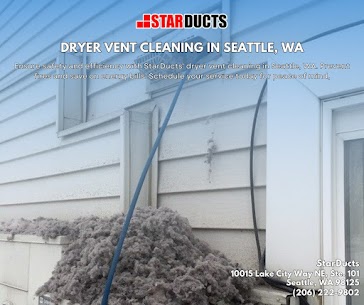
We serve property owners who need extra than a short sweep. If you might be seek Dryer Vent Cleaning Seattle broad, and your vent is something but ordinary, we shall meet the challenge. Our crew has dealt with ample lengthy runs to comprehend that information win. Clean ducts, soft interiors, wise terminations, stable airflow. That is how a dryer finishes lots in cost effective time, makes use of much less vigor, and remains out of the information.
Final mind from the field
Long vent runs are portion of the Seattle panorama, formed by using architecture, weather, and the way houses evolve. The issues they create are predictable, and so are the fixes. If you possess this sort of systems, deal with it like the mechanical meeting it's. Give it average Dryer Vent Cleaning, select the exact areas, and make small enhancements that scale back resistance. The big difference shows up in mins stored, dollars kept, and peace of intellect whilst the dryer hums with no strain.
When you might be in a position, we're right here to support. We will bring gauges, brushes, and a practiced working out of ways lengthy vents behave in this urban. We will go away your formula cleanser, freer, and more easy to sustain. And the subsequent wet day, when you toss in a load of towels, you can actually note the dryer finishing previously your coffee gets cold.